Sunday, September 13, 2020


Rummy-0

Background

Jump to search
Typical Rummy-O tiles and racks.

Rummy-O is a tile-based game for 2 to 4 players. Play the game with two to four people. There are 106 tiles in four different colours, black, red, orange and blue, with numbers from 1 to 13. Included in these tiles are two jokers (wild tiles). There are 106 tiles in the game, including 104 numbered tiles (valued 1 to 13 in four different colours, two copies of each) and two jokers (Smilies). The object of the game is to get rid of all your tiles before anyone else.

Game Pieces

The 106 Rummy-O Tiles

Rummy-O has 106 tiles, 104 number and two joker tiles. The number tiles range in value from one to thirteen in four colours (blue, red, orange and black).  Each colour and number is represented twice. Each player has a rack to hold tiles without revealing the face of the tiles to the other players.

Rules
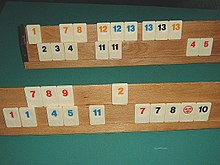
The racks of two players.

Setup -Tiles are placed in a bag and shuffled to ensure that the tiles are well mixed.   Each player collects 14 tiles and arrange them on their racks.  Each draws and reveals one tile. The player whose tile has the highest number will start the game.  Tiles are returned to the bag, and the play begins with the starting player and proceeds in a clockwise direction.

Play - For a player's first move, they must play a set (or sets in some versions) with a value of at least 30 points. Point values are taken from the face value of each tile played, with the joker (if played) assuming the value of the tile it is being used in place of. A player may not use other players' tiles to make the "initial meld". If a player cannot make an initial meld, they must pick up a single tile from the pool and add it to their rack. Play then proceeds to the next player.

Once a player has made their initial meld, they can, on each turn, play one or more tiles from their rack, making or adding to groups and/or runs. If the player cannot (or chooses not to) play any tiles, they must pick a tile from the bag and add it to their rack.

Players may play tiles by amending sets already in play. The only limit to the length of a run is the extremes of the tile values. Groups are limited to four because colours may not repeat within a group.

Sets

All tiles in play must be arranged in sets of at least three tiles. The two valid set types are called runs and groups.

A run is composed of three or more, same-colored tiles, in consecutive number order. (A 1 may not follow a 13.)

Example run:
9
 
10
 
11
 
12

A group is made from three or four same-value tiles in distinct colors. For example: red 3, blue 3, black 3 and orange 3.

Example group:
7
 
7
 
7

Examples of invalid sets

Invalid because numbers are not consecutive:
1
 
2
 
4
Invalid because numbers in a run must all be the same colour:
1
 
2
 
3
Invalid because colours may not repeat in a group (but house rules may allow this):
1
 
1
 
1

Example of play

Tiles already out-played:
3
 
4
 
5
Own tiles:
2
 
5
 
5
Recombined result:
2
 
3
 
4
 and 
5
 
5
 
5

Manipulating existing tiles

During a player's turn, sets of tiles that have already been played may be manipulated to allow more tiles to be played. At the end of the turn, all played tiles must be in valid sets.

Shifting a run
Players may add the appropriate tile to either end of a run and remove a tile from the other end for use elsewhere. If red 3, 4, and 5 have already been played, a player may add the red 6 to the end and remove the 3 for use elsewhere.
Splitting a run
Players may split long runs and insert the corresponding tiles in the middle. Thus, if blue 6, 7, 8, 9, and 10 are already a run, the player may insert his own 8 to make two runs: 6, 7, 8 and 8, 9, 10.
Substituting in a group
Players may replace any of the tiles in a three-tile group with a tile of the fourth color and the same value. If blue 6, red 6, and orange 6 are already a group, the player may add the black 6 and remove any one of the other three for use elsewhere.
Removing tiles
So long as the remaining tiles form a valid run, tiles can be removed from the ends of runs. Any one tile may be removed from a four-tile group.
Joker substitution
A joker may be retrieved before the initial meld. A joker can be retrieved from a set by replacing it with a tile of the same numerical value and colour it represents. The tile used to replace the joker can come from the player's rack or from the table. In the case of a group of 3, the joker can be replaced by the tile of either of the missing colours. A joker that has been replaced must be used in the player's same turn as part of a new set. A set containing a joker can have tiles added to it, be split apart or have tiles removed from it. The joker can be moved or replaced in any possible way as long as you maintain a set of at least three tiles. The joker can be moved or replaced by any missing tile in all possible ways as long as player maintain a set of at least three tiles. The joker has a penalty value of 30 points if it remains on a player's rack at the end of the game[4]
Harvested tiles
In the course of a turn, a tile that is "harvested" from an existing set must be played during the turn; it cannot be kept for later use. Example: if there is a 3, 4, 5 run on the table, the 3 can be harvested by putting down the appropriately colored 6, but the 3 must be used during that turn, not kept in the player's hand for later use.

Scoring

Once a winner has been declared, the losing players must add up the values of the tiles remaining in their racks (their score for the game). The joker has a penalty value of 30. A player's score for the game is subtracted from his current cumulative score. Once calculated, each of the losing players' scores for the game is added to the winners current cumulative score.

For example- suppose in a game player A wins, player B has a score of 5, player C has a score of 10 and player D a score of 3. Player A will now have a cumulative score of 18, player B will be −5, player C will be −10 and player D will be −3.

Should the game result in no winner, the player with the lowest number of tiles in their rack is the winner. Scoring is then carried out in the normal manner.

Winning

Game play continues until a player has used all of the tiles in the rack, at which point they should call out "Rummikub," and are declared the winner. If the pool runs out of tiles, play continues until there is a winner or no player can make a valid play.

Saturday, September 12, 2020

Baked Salmon


This healthy baked salmon is ideal to feed a crowd. There's no skillet cooking, the salmon is oven-baked in foil, making prep and cleanup easy. For this recipe, a bed of lemon slices infuses the fish with a citrusy freshness.

INGREDIENTS

  • 2 lemons, thinly sliced
  • 1 large salmon fillet (about 3 lb.)
  • Kosher salt
  • Freshly ground black pepper
  • 6 tbsp. butter, melted
  • 2 tbsp. honey
  • 3 cloves garlic, minced
  • 1 tsp. chopped thyme leaves
  • 1 tsp. dried oregano
  • Chopped fresh parsley, for garnish

DIRECTIONS

  1. Preheat oven to 350°. 
  2. Line a large rimmed baking sheet with foil and grease with cooking spray. 
  3. Place a layer of lemon slices to the center of the foil.
  4. Season both sides of the salmon with salt and pepper and place it on top of lemon slices.
  5. In a small bowl, whisk together butter, honey, garlic, thyme, and oregano.
  6. Pour over salmon then fold up foil around the salmon.
  7. Bake until the salmon is cooked through, about 25 minutes. 
  8. Switch the oven to broil, and broil for 2 minutes, or until the butter mixture
  9. has thickened.
  10. Garnish with parsley before serving.

Friday, September 11, 2020

Bottling Wine


Wine tamponade tool, manual pressed cork wine bottle cork packing machine,  playing the cork variety tamponade machine|machine machine|tool toolmachine  manual - AliExpress

Bottling is the final step in the winemaking process. Typically red wines are bottled in dark green bottles to prevent UV exposure which can accelerate the ageing process. If red wine is kept in a dark “cellar” environment, the light will not be an issue and any colour can be used.

White wines are typically put in clear bottles as they are not aged nearly as long as red wines.

Closures

A closure is a term for the type of seal used to seal bottles. Most wineries use a cork, synthetic cork, or screw cap. There has been a debate arguing for each type of closure. We’ll briefly touch on them here.

  • Natural Cork -  Is the closure of choice for many winemakers. The benefit of natural cork is its ability to let in a tiny amount of oxygen. The oxygen allows for “micro-oxygenation”, an essential part of long-term bottle ageing. Natural corks have a few drawbacks worth mentioning.  Poorly made corks can deteriorate and leave your wine “corked” (tasting like mouldy cork).  Even high-quality cork producers wind up making a few duds. Once a wine is corked there’s nothing you can do about it.  Another drawback of cork is that they could leak.  Some corks have a little channel on the side of the cork that allows the wine to leak out. The winemaker can’t always see these defects in cork before bottling so it’s a risk that they assume when using corks.

  • Synthetic Cork - Today’s synthetic corks are much improved over the old petroleum-based.  Synthetic corks don’t deteriorate, nor do they have a tendency to leak.  Many synthetic corks do not allow for micro-oxygenation.  This is fine for wine consumed young, but if the wine is aged for several years, natural cork is the best choice.

  • Screw Caps - Largely thought to be a sign of cheap wine.  But lately, they are also being used in more expensive wines.  Proponents of screw caps cite the lack of spoiled wine due to bad corks among their chief benefits.


On the other hand, screw caps don’t allow for micro-oxygenation as a natural cork will. Wine drinkers with a sensitive palate have been able to detect petroleum flavours in wines with this type of closure. As the inside of the cap is coated with plastic to help seal it the wine may in fact pick up undesirable flavours.

Summary

Natural corks are tried and true even if they result in a few bad bottles once in a while. For long-term bottle ageing, they are the best choice.

Ageing Wine


 What's that wine doing in a whiskey barrel? - Chicago Tribune

As red wine ages, the harsh tannins of its youth gradually give way to a softer mouthfeel. An inky dark colour will eventually fade to a light brick red. These changes occur due to the complex chemical reactions of the phenolic compounds of the wine. In processes that begin during fermentation and continue after bottling, these compounds bind together and aggregate. Eventually, these particles reach a certain size where they are too large to stay suspended in the solution and precipitate out. The presence of visible sediment in a bottle will usually indicate a mature wine. The resulting wine, with this loss of tannins and pigment, will have a paler colour and taste softer, less astringent. The sediment, while harmless, can have an unpleasant taste and is often separated from the wine by decanting.

During the ageing process, the perception of a wine's acidity may change even though the total measurable amount of acidity is more or less constant throughout a wine's life. This is due to the esterification of the acids, combining with alcohol in complex array to form esters. In addition to making a wine taste less acidic, these esters introduce a range of possible aromas. Eventually, the wine may age to a point where other components of the wine (such as tannins and fruit) are less noticeable themselves, which will then bring back a heightened perception of wine acidity. Other chemical processes that occur during ageing include the hydrolysis of flavour precursors that detach themselves from glucose molecules and introduce new flavour notes in the older wine and Aldehydes become oxidized. The interaction of certain phenolics develops what is known as tertiary aromas which are different from the primary aromas that are derived from the grape and during fermentation.

As a wine starts to mature, its bouquet will become more developed and multi-layered. While a taster may be able to pick out a few fruit notes in a young wine, more complex wine will have several distinct fruits, floral, earthy, mineral and oak-derived notes. The lingering finish of a wine will lengthen. Eventually, the wine will reach a point of maturity, when it is said to be at its "peak". This is the point when the wine has the maximum amount of complexity, most pleasing mouthfeel and softening of tannins and has not yet started to decay. When this point will occur is not yet predictable and can vary from bottle to bottle. If a wine is aged for too long, it will start to descend into decrepitude where the fruit tastes hollow and weak while the wine's acidity becomes dominant.

Grape Fermentation


Grape to Glass: Fermentation – Wine Sisterhood: Women who love wine, food,  travel, crafts, entertaining

Fermentation is the natural process that turns grape juice into wine, fermentation is actually a chain reaction of chemical responses. During this process, technically called the primary fermentation, the sugars in the grape juice are converted by the enzymes in yeasts into alcohol and carbon dioxide. In addition, fermentation generates minor amounts of numerous incidental by-products that affect the aroma and taste of wine including acetaldehyde, acetic acid (see acids), ethyl acetate, glycerol and alcohols other than ethanol. 

One of the potential problems winemakers must avoid is a stuck fermentation. This occurs when the yeast stops converting the sugar into alcohol and carbon dioxide, thereby prematurely leaving undesirable residual sugar in the wine. As more is learned about fermentation, techniques are evolving to manage the process in order to produce optimum wines. For example, managing the temperature during the fermentation-cooler temperatures (45 to 60°F) for white wines, warmer temperatures (70 to 85°F) for heavier red wines-leads to superior wines.

Red wines are usually fermented with their skins, seeds, and pulp to extract colour and tannins-something not desirable in white wines. yeast strains are also being experimented with to determine which ones work best for different wines under various conditions. Many winemakers believe barrel fermentation adds flavour and complexity to some white wines. carbonic maceration is a specialized fermentation process for producing light fruity red wines.


Harvesting and Crushing Grapes


Grape harvest - Whistler's Knoll

Sample clusters of wine grapes are inspected with a refractometer to determine if the grapes are ready to be picked. The refractometer is a small, hand-held device (the size of a miniature telescope) that accurately checks the amount of sugar in the grapes.

If the grapes are ready for picking, a mechanical harvester gathers and funnels the grapes into a field hopper, or mobile storage container. Some mechanical harvesters have grape crushers mounted on the machinery, allowing vineyard workers to gather grapes and crush them at the same time. The result is that vineyards can deliver newly crushed grapes, called must, eliminating the need for crushing at the winery. This also prevents oxidization of the juice through tears or splits in the grapes' skins.

Mechanical harvesters, or, in some cases, robots, are now used in most medium to large vineyards, thereby eliminating the need for hand-picking. First used in California vineyards in 1968, mechanical harvesters have significantly decreased the time it takes to gather grapes. The harvesters have also allowed grapes to be gathered at night when they are cool, fresh, and ripe.

The field hoppers are transported to the winery where they are unloaded into a crusher-stemmer machine. Some crusher-stemmer machines are hydraulic while others are driven by air pressure.

The grapes are crushed and the stems are removed, leaving liquid must that flows either into a stainless steel fermentation tank or a wooden vat (for fine wines).

Wine Production Process


Making wine remained much the same throughout the ages, but new sophisticated machinery and technology have helped streamline and increase the output of wine. Whether such advances have enhanced the quality of the wine is, however, a subject of debate. These advances include a variety of mechanical harvesters, grape crushers, temperature-controlled tanks, and centrifuges.

The procedures involved in making wine are often times dictated by the grape and the amount and type of wine being produced. Recipes for certain types of wine require the winemaker (the vintner) to monitor and regulate the amount of yeast, the fermentation process, and other steps of the process. While the manufacturing process is highly automated in medium- to large-sized wineries, small wineries still use hand-operated presses and store wine in musty wine cellars.

A universal factor in the production of fine wine is timing. This includes picking grapes at the right time, removing the must at the right time, monitoring and regulating fermentation, and storing the wine long enough.
The wine-making process can be divided into four distinct steps: 

  • Harvesting and crushing grapes
  • Fermenting must
  • Ageing 
  • Bottling

Thursday, September 10, 2020


Analog Telephone Adapter (ATA)

An analog telephony adapter or analog telephone adapter (ATA) is a device used to connect one or more standard analog telephones to a digital telephone system (such as Voice over Internet Protocol, VOIP) or a non-standard telephone system.

An ATA is usually a small box with a power adapter, one Ethernet port, and one or more telephone ports.  Users can plug one or more standard analog telephone devices into the ATA and the analog device(s) will operate, usually transparently, on a VoIP network.

Since the ATA communicates directly with the VoIP server, it does not require a personal computer or any software such as a softphone.
 

Purpose


An ATA connects between a broadband internet connection and an existing telephone.   ATAs are used by many VoIP companies selling a VoIP service, where the device is used to replace traditional telephone companies. When sold in connection with a VoIP service, the ATA is often locked so it cannot be used with a competing service, and the user can only partly change its configuration. Some providers do sell devices that are not locked and can be used with any compatible provider. This type of service, which is fixed to one location, is generally offered by broadband Internet providers such as cable companies and telephone companies as a cheaper flat-rate traditional phone service.

 Home-made Ricotta


Ricotta is easy to make and it tastes so special that you will want to make it weekly to have on hand for eating and cooking. You will need to have a cooking thermometer to ensure success.

  • Yield: 4 cups (about 2 pounds)
  • Preparation Time:
  • 5 minutes, plus 2 hours resting and 2 hours draining
  • Cooking Time: 20-30 minutes

Ingredients

  • 1 gallon whole pasteurized milk
  • 1/2 teaspoon salt
  • 1/3 cup plus 1 tablespoon distilled white vinegar

Method

  1. Use a large, heavy-gauge stainless-steel saucepot. Wash it thoroughly with very hot water, but do not bother to dry it. (Leaving it wet helps prevent the milk from scorching.) Place the milk in the saucepot over medium heat. Add the salt and stir briefly. Allow the milk to heat up slowly, stirring occasionally with a metal spatula. When you notice tiny bubbles and steam forming on the surface of the milk, stir more frequently; don't let it scorch. You want it to reach 190 degrees F, near scalding temperature, just before boiling. Check the temperature with your thermometer periodically.
  2. When it reaches the correct temperature, turn the heat off, add the vinegar, and stir gently for 1 minute. You will notice curds forming immediately. Take the pot off the stove. Cover with a dry, clean dish towel and allow the mixture to sit undisturbed for 2 hours. On cold days, you can prepare your ricotta in the morning before going to work and let it sit until you come home.
  3. When the ricotta has rested for 2 or more hours, take a piece of cheesecloth, dampen it with water, and lay it out inside a colander. With a slotted spoon or sieve, ladle out the ricotta into the prepared colander. Place the colander with the ricotta inside a larger pan or bowl so it can drain freely. Let it drain for 2 hours or longer.
  4. Store the cheese in a covered container in the refrigerator.


Bocce


Bocce is a bowling game in which teams lob or roll the bocce (balls) toward a smaller target ball, called the Pallino. The object is to get a ball closer to the Pallino than the opponent's ball. Teams are needed to play Bocce. The teams can be made up of one, two, three, four or more persons per team. One point is awarded to a given team for every ball that is closer to the Pallino than the closest ball of the opposing team. The team which wins a frame on points starts to play in the next frame. A game consists of 12 points.

History

Throwing balls toward a target is the oldest game known to mankind. As early as 5000 B.C. the Egyptians played a form of bocce with polished rocks. Graphic representations of figures tossing a ball or polished stone have been recorded as early as 5200 B.C. While bocce today looks quite different from its early predecessors, the objective of trying to come as close to a fixed target as possible has not changed. From this early objective, the basic rules of bocce were born. From Egypt, the game made its way to Greece around 800 B.C. The Romans learned the game from the Greeks, then introduced it throughout the empire.

In modern times, the first bocce clubs were organized in Italy. Notably, the first Italian League was formed in 1947 by fifteen teams in and around the town of Rivoli (Torino). 1947 also marks the beginning of the yearly Bocce World Championships.

Thanks to many Italian immigrants, bocce has come to flourish in the United States and Canada. During its beginnings in North America, there were as many versions of the game as there were towns the immigrants had left. Bringing some order to the game is the Collegium Cosmicum ad Buxeas, the bocce organization headquartered in Rome, Italy.

The Italian Tradition


Italy has produced the main game. It began and remains predominantly an open-air activity, played on long, rectangular courts improvised from rough village spaces during the hot, dry summers. The surface consists of raked sand or gravel. The game is still often played informally in the village and cafe tradition by men of all ages, but it has now acquired a national and international competitive form and, in many cases, dedicated indoor facilities (like the one at the Dante Club Bocciofila in Sarnia, Ontario) makes it possible for year-round play.

Although it now has the superstructures of a modern sport, bocce is still largely local and recreational in its appeal. Given its peasant origins, it is hardly surprising that it remains male-dominated, although a number of mixed leagues have sprung up. Despite its growing complexity, its appeal lies in its being a "sport simpatico e popolare" in the words of a recent enthusiast --something essentially part of an Italian summer.

Bocce Links
Bocce Standards Association
Joy of Bocce
Bocce Volo

All about Wine


Background

Wine is an alcoholic beverage produced through the partial or total fermentation of grapes. Other fruits and plants, such as berries, apples, cherries, dandelions, elder-berries, palm, and rice can also be fermented.

Grapes belong to the botanical family Vitaceae, of which there are many species. The species that are most widely used in wine production are Vitis labrusca and, especially, Vitis vinifera, which has long been the most widely used wine grape throughout the world.

The theory that wine was discovered by accident is most likely correct because wine grapes contain all the necessary ingredients for wine, including pulp, juice, and seeds that possess all the acids, sugars, tannins, minerals, and vitamins that are found in wine. As a natural process, the frosty-looking skin of the grape, called "bloom," catches the airborne yeast and enzymes that ferment the juice of the grape into wine.

The cultivation of wine grapes for the production of wine is called "viticulture." Harvested during the fall, wine grapes may range in colour from pale yellow to hearty green to ruby red.

Wine can be made in the home and in small-, medium- or large-sized wineries by using similar methods. Wine is made in a variety of flavours, with varying degrees of sweetness or dryness as well as alcoholic strength and quality. Generally, the strength, colour, and flavour of the wine are controlled during the fermentation process.

Wine is characterized by colour: white, pink or rose, and red, and it can range in alcohol content from 10 percent to 14 percent. Wine types can be divided into four broad categories: table wines, sparkling wines, fortified wines, and aromatic wines. Table wines include a range of red, white, and rose wines; sparkling wines include champagne and other "bubbly" wines; aromatic wines contain fruits, plants, and flowers; and fortified wines are table wines with brandy or other alcohol added.

The name of wine almost invariably is derived from one of three sources: the name of the principal grape from which it was made, the geographical area from which it comes, or—in the case of the traditionally finest wines—from a particular vineyard or parcel of soil. The year in which a wine is made is only printed on bottles that have aged for two or more years; those aged less are not considered worthy of a date. Wine years are known as "vintages" or "vintage years." While certain wines are considered good or bad depending on the year they were produced, this can vary by locality.

In general, red wines are supposed to age from seven to ten years before being sold. Because white and rose wines are not enhanced by additional ageing, they are usually aged from only one to four years before being sold. And, since the quality of wine can depend on proper ageing, older wines are generally more expensive than younger ones. Other factors, however, can affect the quality of the wine, and proper ageing does not always ensure quality. Other factors affecting quality include the grapes themselves, when the grapes are picked, proper care of the grapes, the fermentation process, as well as other aspects of wine production.

Most wineries bottle wine in different size bottles and have different products and graphic designs on their labels. The most common bottle sizes are the half bottle, the imperial pint, the standard bottle, and the gallon bottle or jug. Most red and rose wine bottles are coloured to keep light from ageing the wine further after they are on the market.

While viticulture has remained much the same for centuries, new technology has helped increase the output and variety of wine.

HISTORY

Well documented in numerous Biblical references, evidence of wine can be traced back to Egypt as far as 5,000 B.C. Tomb wall paintings showing the use of wine as well as actual wine jars found in Egyptian tombs provide evidence of this fact. Because more northern climates and soil produce better wine, the growth of the wine industry can be traced from its emergence along the Nile River in Egypt and Persia northward into Europe and, eventually, to North America.

Though the wines of old were coarse and hard and had to be mixed with water, ancient Greek wine proved to be somewhat better than Egyptian wine. For this reason, Egyptians began importing it. Then Roman wines (from what would emerge to be Italy, Spain, and France) became notably superior. Eventually, French and German wines grew to be the most desirable, thereby shifting the center of wine production from the Mediterranean to central Europe. Some of the best wine in the world is still produced in southern France, particularly in the Bordeaux region, where wine has been made for more than 2,000 years.

The colonists brought wine production to the east coast of the New World by the mid-1600s. The earliest account of wine used in the New World may be when the Pilgrims fermented grapes to celebrate their first Thanksgiving in 1623. Settlers tried to grow imported grape cuttings they brought from Europe, but unfortunately, the European cuttings had not developed immunities to the North American plant diseases that eventually killed them. By the middle of the nineteenth century (using the fruits of the abundant native Vitis labrusca grape plants) wineries were established in Pennsylvania, Virginia, Ohio, Indiana, Alabama, Mississippi, and North Carolina.

In 1697, European cuttings of Vitis vinifera grapes were successfully introduced to California by Franciscan priests at the Mission San Francisco Xavier. They soon became the dominant grape species in California winemaking. A great boost to California winemaking came from Colonel Agoston Haraszthy, a Hungarian nobleman, who introduced more high-quality European cuttings during the 1850s. His knowledge made him the founder of California's modern wine industry.

Today, California and New York state are by far the largest American producers of wine, and California is one of the largest wine producers in the world. Though many of its table wines are known for their quality, the enormous wineries of central and southern California produce gigantic quantities of neutral, bulk wines that they ship elsewhere to make specific wines, such as dessert wines, or to blend with other wines. They also make grape concentrates to fortify weaker wines and brandies that use large quantities of grapes.

Raw Materials

As mentioned above, the wine grape itself contains all the necessary ingredients for wine: pulp, juice, sugars, acids, tannins, and minerals. However, some manufacturers add yeast to increase strength and cane or beet sugar to increase alcoholic content. During fermentation, winemakers also usually add sulphur dioxide to control the growth of wild yeasts.

Braciole (Flank Steak)


Braciole – Rolled Flank Steak


Braciole

Ingredients

  • 3 cups tomato sauce
  • 1 1/4 cups flavoured croutons
  • 1/3 cup grated Parmesan
  • 2 eggs
  • 1 tablespoon chopped fresh parsley
  • 1 tablespoon chopped fresh oregano
  • 1 teaspoon finely chopped rosemary
  • 1 teaspoon finely chopped thyme
  • 1 clove garlic
  • 1 pound flank steak, pounded to 1/4-inch thick
  • Olive oil, for brushing
  • Salt and pepper
  • Vegetable oil, for searing

Method

  1. Preheat the oven to 350 degrees F. Place the tomato sauce in a 9 by 13-inch baking dish and place in the oven to heat.
  2. In a bowl of a food processor mix the croutons, cheese, eggs, herbs and garlic until it forms a paste.
  3. Brush the pounded flank steak with the olive oil and season generously with the salt and pepper. Spread the filling evenly over the meat. Roll tightly and tie with butcher's twine.
  4. In a large saute pan heat 1 to 2 tablespoons of vegetable oil and sear all sides of the rolled meat. Remove from the pan.
  5. Add to the hot tomato sauce, cover with a tin foil tent so that the foil is not touching the meat. Braise for 35 minutes or, up to 3 hours.

Soppressata


Home-made Soppressata Calabrese (Salami)


Soppressata
Soppressata is a pressed salami available all over Italy. Soppressata Calabrese is made with coarsely ground fresh pork. The ham and the tenderloin cuts make the best salami. The pork is ground through a 25 mm die and mixed with salt and spices. It is packed into large intestines, tied with butcher string, placed under a wooden board and weighted down to obtain the traditional flat shape. It is then hung and cured for 3-4 months.

This recipe comes from Bruno (The Breadman in Sarnia). Bruno was kind enough to share his recipe with us “Ciociari”, Domenic, Ernie, Onorio and Elio. We gathered in Domenic’s cantina kitchen (the Dungeon as Domenic calls it) to learn the fine art of salami making, grill pork chops and sausages over an open fire and to consume a few litres of homemade wine.

Ingredients
    • 10 kg of coarsely lean ground pork – use ham and filet.
    • 180 g of curing salt
    • 2 glasses of red wine
    • 100 g of black peppercorns
    • Large hog casing – cut into 50 cm lengths
    Note: Other spices may be added as desired.

    Method

    1. Place the meat on a plywood board (3’ x 4’) for mixing. Add the curing salt, peppercorns and wine.

    2. Using both hands mix the ingredients thoroughly. Grab handfuls of meat and squeeze till the meat oozes out between your fingers. Continue working the meat until it becomes very sticky (approximately 20 minutes).

    3. Slide the casing over the funnel of the sausage-stuffing machine. Tie one end of the casing with butcher string. Stuff the meat mixture into the casing. Tie into 8-10 inch lengths. Poke holes in the casing with a large needle to let the air out.

    4. Using butcher string tie the salami tightly, approximately 25 mm apart.

    5. Dip the ends of the salami in salt.
    6. Place clean towels or rags on the bottom a wooden box (a grape case will do.

    7. Layer the salami in the box on top of the towels. Continue layering until they are all tightly packed in the box.

    8. Place a piece of plywood to completely cover the top layer and add a 20 kg weight (20-litre plastic pail full of water).

    9. Keep in a cool cellar for 2 days.

    10. Remove from the crate and hang for 2 days. Ensure that they do not touch each other.

    11. Repack the salami in the crate and double the weight. Make sure that the salami is placed back into the crate in the same direction to keep the flat shape. Let sit for 24 hours.

    12. Hang in a cool, moist cellar for 3-4 months for curing.

    Wednesday, September 9, 2020

    Risotto

    Basic Risotto Recipe | EatingWell


    Risotto The Easy Way

    This recipe simplifies the process of making risotto. The classic risotto recipe has been modified to eliminate constant stirring.

    Ingredients

    (Serves 4)
    • 1 cup of Arborio rice
    • 1 small onion finely chopped
    • 1 clove of garlic finely chopped
    • 2 1/2 cups of chicken broth
    • 2 tablespoons of extra virgin olive oil
    • 2 tablespoons of butter
    • 2 tablespoons of grated Parmeggiano Reggiano cheese
    • Salt and pepper to taste

    Method

    1. In a saucepan, heat the olive oil
    2. Add the onion and the garlic. Do not brown, just soften.
    3. Add the rice and stir for 1 minute to coat the rice with the oil..
    4. Add the chicken stock and bring to a boil.
    5. Cover and lower the heat to the lowest setting. Simmer for 20 minutes.
    6. Add salt and pepper to taste.
    7. Stir in the butter and the cheese.
    8. Serve with a nice salad and a glass of your favourite wine. Enjoy.

    Tuesday, September 8, 2020

    Grilled Rib-Eye

    GRILLED RIB-EYE WITH ANCHOVIES, MUSTARD, AND GARLIC
    • 2 prime rib-eye steaks, cut 2 1/2 inches thick
    • 10 ounces canned anchovies, drained and patted dry
    • 6 tablespoons whole-grain mustard
    • 4 tablespoons fresh crushed garlic
    • 4 tablespoons olive oil
    • Freshly ground pepper
    Puree the anchovy, mustard, and garlic in a food processor or blender, to form a paste then blend in the olive oil in a stream. Grind some pepper onto the steaks. Rub the steak thoroughly with the marinade and let the steaks marinate in the refrigerator for 2 days. Grill the steaks to the desired temperature.


     Grilled Eggplant Moussaka

    What makes the difference in this traditional Greek recipe is the grilled, not fried, vegetables, including eggplant, potatoes, and zucchini. It's a lighter version of the famous Greek dish consumed in great quantities every summer.

    Igredients:
    Mussaka
    • 3 large eggplant, sliced into 1/4 inch rounds
    • 3 large potatoes, thinly sliced
    • 3 large zucchini, cut lengthwise into 1/4 inch slices
    • 1/2 cup extra-virgin olive oil
    • 5 tablespoons butter
    • 7 tablespoons all-purpose flour
    • 5 cups of milk
    • 1 pinch ground nutmeg salt to taste
    • 1 egg yolk, beaten
    • 1 tablespoon olive oil
    • 1 1/2 pounds ground beef
    • 1 onion, chopped
    • 1 teaspoon oregano
    • salt and pepper to taste
    • 1/2 cup chopped fresh parsley
    • 5 ripe tomatoes, chopped
    • 1 cup crumbled feta cheese
    Directions:
    1. Preheat an outdoor grill for medium-high heat and lightly oil grate.
    2. Brush eggplant, potatoes, and zucchini lightly with extra-virgin olive oil. Grill vegetables until just tender and golden brown. Layer potatoes into the bottom of a 9x13 inch glass baking dish. Next, layer in the eggplant, followed by the zucchini; set aside.
    3. Preheat oven to 375 degrees F (190 degrees C).
    4. Melt butter in a large saucepan over medium heat. Whisk in the flour, and cook until the flour smells slightly toasted about 5 minutes. Whisk in milk, nutmeg, and salt. Bring to a bare simmer over medium-high heat, then reduce heat to medium-low and simmer 10 minutes. Place the egg yolk into a bowl, and quickly whisk in 1/4 cup of the thickened milk, a tablespoon at a time. Quickly stir the egg yolk mixture into the thickened milk until smooth, then set aside.
    5. Meanwhile, heat 1 tablespoon of olive oil in a large skillet over medium-high heat. Stir in the ground beef and onion, and cook until the beef is crumbly and no longer pink. Drain off any excess grease, then stir in the oregano, parsley, tomatoes, salt, and pepper. Turn heat to medium-low, cover, and simmer for 10 minutes, stirring occasionally.
    6. To assemble, spread the meat mixture over the vegetables, and sprinkle with the feta cheese. Pour the white sauce over top, and smooth with a spatula.
    7. Bake moussaka in the preheated oven until bubbly and golden brown, about 30 minutes.

    Fettuccine With Clam Sauce

    This is one of my favourite pasta dishes. It is very quick to prepare and it can be on the table in less than half an hour.


    Ingredients:

    • 1 pound of fettuccine
    • 10 oz can whole baby clams with juice
    • 6 Roma tomatoes - peeled and diced
    • pinch red chili flakes or to taste
    • 3 cloves of minced garlic
    • 4 tablespoons of extra virgin olive oil
    • salt and black pepper to taste
    • ½ cup chopped fresh basil
    • ½ cup chopped fresh Italian parsley

    Directions:

    1. Bring a large pot of water to a boil. Add one tablespoon of salt and cook the pasta 2 minutes less than the package instructions.
    2. While water is coming to a boil and pasta is cooking, in a large skillet, heat 4 tablespoons of olive oil and saute the garlic.
    3. Add a pinch of hot red pepper flakes. When the garlic has softened, drain the liquid from the clams into the skillet.
    4. Increase the heat to evaporate most of the liquid. Stir frequently for about 4 minutes until the liquid starts to froth.
    5. Add the diced tomatoes and cook for another 5 minutes on high heat to reduce and intensify sauce. Add the clams and cook for another 2 minutes.
    6. When the pasta is very al dente (about 2 minutes less than the package instructions), reserve one cup of the pasta water and drain.
    7. Add the drained pasta to the skillet containing the clams and continue to cook, stirring frequently.
    8. Add enough of the reserved pasta water to the pasta to obtain the desired consistency and continue tossing until the pasta is cooked.
    9. Transfer the pasta to a serving platter and toss with the chopped basil and parsley.

    Serves 4