Sunday, September 13, 2020


Rummy-0

Background

Jump to search
Typical Rummy-O tiles and racks.

Rummy-O is a tile-based game for 2 to 4 players. Play the game with two to four people. There are 106 tiles in four different colours, black, red, orange and blue, with numbers from 1 to 13. Included in these tiles are two jokers (wild tiles). There are 106 tiles in the game, including 104 numbered tiles (valued 1 to 13 in four different colours, two copies of each) and two jokers (Smilies). The object of the game is to get rid of all your tiles before anyone else.

Game Pieces

The 106 Rummy-O Tiles

Rummy-O has 106 tiles, 104 number and two joker tiles. The number tiles range in value from one to thirteen in four colours (blue, red, orange and black).  Each colour and number is represented twice. Each player has a rack to hold tiles without revealing the face of the tiles to the other players.

Rules
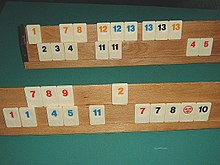
The racks of two players.

Setup -Tiles are placed in a bag and shuffled to ensure that the tiles are well mixed.   Each player collects 14 tiles and arrange them on their racks.  Each draws and reveals one tile. The player whose tile has the highest number will start the game.  Tiles are returned to the bag, and the play begins with the starting player and proceeds in a clockwise direction.

Play - For a player's first move, they must play a set (or sets in some versions) with a value of at least 30 points. Point values are taken from the face value of each tile played, with the joker (if played) assuming the value of the tile it is being used in place of. A player may not use other players' tiles to make the "initial meld". If a player cannot make an initial meld, they must pick up a single tile from the pool and add it to their rack. Play then proceeds to the next player.

Once a player has made their initial meld, they can, on each turn, play one or more tiles from their rack, making or adding to groups and/or runs. If the player cannot (or chooses not to) play any tiles, they must pick a tile from the bag and add it to their rack.

Players may play tiles by amending sets already in play. The only limit to the length of a run is the extremes of the tile values. Groups are limited to four because colours may not repeat within a group.

Sets

All tiles in play must be arranged in sets of at least three tiles. The two valid set types are called runs and groups.

A run is composed of three or more, same-colored tiles, in consecutive number order. (A 1 may not follow a 13.)

Example run:
9
 
10
 
11
 
12

A group is made from three or four same-value tiles in distinct colors. For example: red 3, blue 3, black 3 and orange 3.

Example group:
7
 
7
 
7

Examples of invalid sets

Invalid because numbers are not consecutive:
1
 
2
 
4
Invalid because numbers in a run must all be the same colour:
1
 
2
 
3
Invalid because colours may not repeat in a group (but house rules may allow this):
1
 
1
 
1

Example of play

Tiles already out-played:
3
 
4
 
5
Own tiles:
2
 
5
 
5
Recombined result:
2
 
3
 
4
 and 
5
 
5
 
5

Manipulating existing tiles

During a player's turn, sets of tiles that have already been played may be manipulated to allow more tiles to be played. At the end of the turn, all played tiles must be in valid sets.

Shifting a run
Players may add the appropriate tile to either end of a run and remove a tile from the other end for use elsewhere. If red 3, 4, and 5 have already been played, a player may add the red 6 to the end and remove the 3 for use elsewhere.
Splitting a run
Players may split long runs and insert the corresponding tiles in the middle. Thus, if blue 6, 7, 8, 9, and 10 are already a run, the player may insert his own 8 to make two runs: 6, 7, 8 and 8, 9, 10.
Substituting in a group
Players may replace any of the tiles in a three-tile group with a tile of the fourth color and the same value. If blue 6, red 6, and orange 6 are already a group, the player may add the black 6 and remove any one of the other three for use elsewhere.
Removing tiles
So long as the remaining tiles form a valid run, tiles can be removed from the ends of runs. Any one tile may be removed from a four-tile group.
Joker substitution
A joker may be retrieved before the initial meld. A joker can be retrieved from a set by replacing it with a tile of the same numerical value and colour it represents. The tile used to replace the joker can come from the player's rack or from the table. In the case of a group of 3, the joker can be replaced by the tile of either of the missing colours. A joker that has been replaced must be used in the player's same turn as part of a new set. A set containing a joker can have tiles added to it, be split apart or have tiles removed from it. The joker can be moved or replaced in any possible way as long as you maintain a set of at least three tiles. The joker can be moved or replaced by any missing tile in all possible ways as long as player maintain a set of at least three tiles. The joker has a penalty value of 30 points if it remains on a player's rack at the end of the game[4]
Harvested tiles
In the course of a turn, a tile that is "harvested" from an existing set must be played during the turn; it cannot be kept for later use. Example: if there is a 3, 4, 5 run on the table, the 3 can be harvested by putting down the appropriately colored 6, but the 3 must be used during that turn, not kept in the player's hand for later use.

Scoring

Once a winner has been declared, the losing players must add up the values of the tiles remaining in their racks (their score for the game). The joker has a penalty value of 30. A player's score for the game is subtracted from his current cumulative score. Once calculated, each of the losing players' scores for the game is added to the winners current cumulative score.

For example- suppose in a game player A wins, player B has a score of 5, player C has a score of 10 and player D a score of 3. Player A will now have a cumulative score of 18, player B will be −5, player C will be −10 and player D will be −3.

Should the game result in no winner, the player with the lowest number of tiles in their rack is the winner. Scoring is then carried out in the normal manner.

Winning

Game play continues until a player has used all of the tiles in the rack, at which point they should call out "Rummikub," and are declared the winner. If the pool runs out of tiles, play continues until there is a winner or no player can make a valid play.

Saturday, September 12, 2020

Baked Salmon


This healthy baked salmon is ideal to feed a crowd. There's no skillet cooking, the salmon is oven-baked in foil, making prep and cleanup easy. For this recipe, a bed of lemon slices infuses the fish with a citrusy freshness.

INGREDIENTS

  • 2 lemons, thinly sliced
  • 1 large salmon fillet (about 3 lb.)
  • Kosher salt
  • Freshly ground black pepper
  • 6 tbsp. butter, melted
  • 2 tbsp. honey
  • 3 cloves garlic, minced
  • 1 tsp. chopped thyme leaves
  • 1 tsp. dried oregano
  • Chopped fresh parsley, for garnish

DIRECTIONS

  1. Preheat oven to 350°. 
  2. Line a large rimmed baking sheet with foil and grease with cooking spray. 
  3. Place a layer of lemon slices to the center of the foil.
  4. Season both sides of the salmon with salt and pepper and place it on top of lemon slices.
  5. In a small bowl, whisk together butter, honey, garlic, thyme, and oregano.
  6. Pour over salmon then fold up foil around the salmon.
  7. Bake until the salmon is cooked through, about 25 minutes. 
  8. Switch the oven to broil, and broil for 2 minutes, or until the butter mixture
  9. has thickened.
  10. Garnish with parsley before serving.

Friday, September 11, 2020

Bottling Wine


Wine tamponade tool, manual pressed cork wine bottle cork packing machine,  playing the cork variety tamponade machine|machine machine|tool toolmachine  manual - AliExpress

Bottling is the final step in the winemaking process. Typically red wines are bottled in dark green bottles to prevent UV exposure which can accelerate the ageing process. If red wine is kept in a dark “cellar” environment, the light will not be an issue and any colour can be used.

White wines are typically put in clear bottles as they are not aged nearly as long as red wines.

Closures

A closure is a term for the type of seal used to seal bottles. Most wineries use a cork, synthetic cork, or screw cap. There has been a debate arguing for each type of closure. We’ll briefly touch on them here.

  • Natural Cork -  Is the closure of choice for many winemakers. The benefit of natural cork is its ability to let in a tiny amount of oxygen. The oxygen allows for “micro-oxygenation”, an essential part of long-term bottle ageing. Natural corks have a few drawbacks worth mentioning.  Poorly made corks can deteriorate and leave your wine “corked” (tasting like mouldy cork).  Even high-quality cork producers wind up making a few duds. Once a wine is corked there’s nothing you can do about it.  Another drawback of cork is that they could leak.  Some corks have a little channel on the side of the cork that allows the wine to leak out. The winemaker can’t always see these defects in cork before bottling so it’s a risk that they assume when using corks.

  • Synthetic Cork - Today’s synthetic corks are much improved over the old petroleum-based.  Synthetic corks don’t deteriorate, nor do they have a tendency to leak.  Many synthetic corks do not allow for micro-oxygenation.  This is fine for wine consumed young, but if the wine is aged for several years, natural cork is the best choice.

  • Screw Caps - Largely thought to be a sign of cheap wine.  But lately, they are also being used in more expensive wines.  Proponents of screw caps cite the lack of spoiled wine due to bad corks among their chief benefits.


On the other hand, screw caps don’t allow for micro-oxygenation as a natural cork will. Wine drinkers with a sensitive palate have been able to detect petroleum flavours in wines with this type of closure. As the inside of the cap is coated with plastic to help seal it the wine may in fact pick up undesirable flavours.

Summary

Natural corks are tried and true even if they result in a few bad bottles once in a while. For long-term bottle ageing, they are the best choice.

Ageing Wine


 What's that wine doing in a whiskey barrel? - Chicago Tribune

As red wine ages, the harsh tannins of its youth gradually give way to a softer mouthfeel. An inky dark colour will eventually fade to a light brick red. These changes occur due to the complex chemical reactions of the phenolic compounds of the wine. In processes that begin during fermentation and continue after bottling, these compounds bind together and aggregate. Eventually, these particles reach a certain size where they are too large to stay suspended in the solution and precipitate out. The presence of visible sediment in a bottle will usually indicate a mature wine. The resulting wine, with this loss of tannins and pigment, will have a paler colour and taste softer, less astringent. The sediment, while harmless, can have an unpleasant taste and is often separated from the wine by decanting.

During the ageing process, the perception of a wine's acidity may change even though the total measurable amount of acidity is more or less constant throughout a wine's life. This is due to the esterification of the acids, combining with alcohol in complex array to form esters. In addition to making a wine taste less acidic, these esters introduce a range of possible aromas. Eventually, the wine may age to a point where other components of the wine (such as tannins and fruit) are less noticeable themselves, which will then bring back a heightened perception of wine acidity. Other chemical processes that occur during ageing include the hydrolysis of flavour precursors that detach themselves from glucose molecules and introduce new flavour notes in the older wine and Aldehydes become oxidized. The interaction of certain phenolics develops what is known as tertiary aromas which are different from the primary aromas that are derived from the grape and during fermentation.

As a wine starts to mature, its bouquet will become more developed and multi-layered. While a taster may be able to pick out a few fruit notes in a young wine, more complex wine will have several distinct fruits, floral, earthy, mineral and oak-derived notes. The lingering finish of a wine will lengthen. Eventually, the wine will reach a point of maturity, when it is said to be at its "peak". This is the point when the wine has the maximum amount of complexity, most pleasing mouthfeel and softening of tannins and has not yet started to decay. When this point will occur is not yet predictable and can vary from bottle to bottle. If a wine is aged for too long, it will start to descend into decrepitude where the fruit tastes hollow and weak while the wine's acidity becomes dominant.

Grape Fermentation


Grape to Glass: Fermentation – Wine Sisterhood: Women who love wine, food,  travel, crafts, entertaining

Fermentation is the natural process that turns grape juice into wine, fermentation is actually a chain reaction of chemical responses. During this process, technically called the primary fermentation, the sugars in the grape juice are converted by the enzymes in yeasts into alcohol and carbon dioxide. In addition, fermentation generates minor amounts of numerous incidental by-products that affect the aroma and taste of wine including acetaldehyde, acetic acid (see acids), ethyl acetate, glycerol and alcohols other than ethanol. 

One of the potential problems winemakers must avoid is a stuck fermentation. This occurs when the yeast stops converting the sugar into alcohol and carbon dioxide, thereby prematurely leaving undesirable residual sugar in the wine. As more is learned about fermentation, techniques are evolving to manage the process in order to produce optimum wines. For example, managing the temperature during the fermentation-cooler temperatures (45 to 60°F) for white wines, warmer temperatures (70 to 85°F) for heavier red wines-leads to superior wines.

Red wines are usually fermented with their skins, seeds, and pulp to extract colour and tannins-something not desirable in white wines. yeast strains are also being experimented with to determine which ones work best for different wines under various conditions. Many winemakers believe barrel fermentation adds flavour and complexity to some white wines. carbonic maceration is a specialized fermentation process for producing light fruity red wines.


Harvesting and Crushing Grapes


Grape harvest - Whistler's Knoll

Sample clusters of wine grapes are inspected with a refractometer to determine if the grapes are ready to be picked. The refractometer is a small, hand-held device (the size of a miniature telescope) that accurately checks the amount of sugar in the grapes.

If the grapes are ready for picking, a mechanical harvester gathers and funnels the grapes into a field hopper, or mobile storage container. Some mechanical harvesters have grape crushers mounted on the machinery, allowing vineyard workers to gather grapes and crush them at the same time. The result is that vineyards can deliver newly crushed grapes, called must, eliminating the need for crushing at the winery. This also prevents oxidization of the juice through tears or splits in the grapes' skins.

Mechanical harvesters, or, in some cases, robots, are now used in most medium to large vineyards, thereby eliminating the need for hand-picking. First used in California vineyards in 1968, mechanical harvesters have significantly decreased the time it takes to gather grapes. The harvesters have also allowed grapes to be gathered at night when they are cool, fresh, and ripe.

The field hoppers are transported to the winery where they are unloaded into a crusher-stemmer machine. Some crusher-stemmer machines are hydraulic while others are driven by air pressure.

The grapes are crushed and the stems are removed, leaving liquid must that flows either into a stainless steel fermentation tank or a wooden vat (for fine wines).