Rummy-0
Background

Rummy-O is a tile-based game for 2 to 4 players. Play the game with two to four people. There are 106 tiles in four different colours, black, red, orange and blue, with numbers from 1 to 13. Included in these tiles are two jokers (wild tiles). There are 106 tiles in the game, including 104 numbered tiles (valued 1 to 13 in four different colours, two copies of each) and two jokers (Smilies). The object of the game is to get rid of all your tiles before anyone else.
Game Pieces

Rummy-O has 106 tiles, 104 number and two joker tiles. The number tiles range in value from one to thirteen in four colours (blue, red, orange and black). Each colour and number is represented twice. Each player has a rack to hold tiles without revealing the face of the tiles to the other players.
Rules
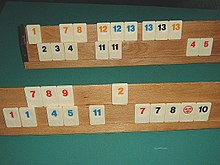
Setup -Tiles are placed in a bag and shuffled to ensure that the tiles are well mixed. Each player collects 14 tiles and arrange them on their racks. Each draws and reveals one tile. The player whose tile has the highest number will start the game. Tiles are returned to the bag, and the play begins with the starting player and proceeds in a clockwise direction.
Once a player has made their initial meld, they can, on each turn, play one or more tiles from their rack, making or adding to groups and/or runs. If the player cannot (or chooses not to) play any tiles, they must pick a tile from the bag and add it to their rack.
Players may play tiles by amending sets already in play. The only limit to the length of a run is the extremes of the tile values. Groups are limited to four because colours may not repeat within a group.
Sets
All tiles in play must be arranged in sets of at least three tiles. The two valid set types are called runs and groups.
A run is composed of three or more, same-colored tiles, in consecutive number order. (A 1 may not follow a 13.)
Example run: 9101112
A group is made from three or four same-value tiles in distinct colors. For example: red 3, blue 3, black 3 and orange 3.
Example group: 777
Examples of invalid sets
Invalid because numbers are not consecutive: 124Invalid because numbers in a run must all be the same colour: 123Invalid because colours may not repeat in a group (but house rules may allow this): 111
Example of play
Tiles already out-played: 345Own tiles: 255Recombined result: 234and555
Manipulating existing tiles
During a player's turn, sets of tiles that have already been played may be manipulated to allow more tiles to be played. At the end of the turn, all played tiles must be in valid sets.
- Shifting a run
- Players may add the appropriate tile to either end of a run and remove a tile from the other end for use elsewhere. If red 3, 4, and 5 have already been played, a player may add the red 6 to the end and remove the 3 for use elsewhere.
- Splitting a run
- Players may split long runs and insert the corresponding tiles in the middle. Thus, if blue 6, 7, 8, 9, and 10 are already a run, the player may insert his own 8 to make two runs: 6, 7, 8 and 8, 9, 10.
- Substituting in a group
- Players may replace any of the tiles in a three-tile group with a tile of the fourth color and the same value. If blue 6, red 6, and orange 6 are already a group, the player may add the black 6 and remove any one of the other three for use elsewhere.
- Removing tiles
- So long as the remaining tiles form a valid run, tiles can be removed from the ends of runs. Any one tile may be removed from a four-tile group.
- Joker substitution
- A joker may be retrieved before the initial meld. A joker can be retrieved from a set by replacing it with a tile of the same numerical value and colour it represents. The tile used to replace the joker can come from the player's rack or from the table. In the case of a group of 3, the joker can be replaced by the tile of either of the missing colours. A joker that has been replaced must be used in the player's same turn as part of a new set. A set containing a joker can have tiles added to it, be split apart or have tiles removed from it. The joker can be moved or replaced in any possible way as long as you maintain a set of at least three tiles. The joker can be moved or replaced by any missing tile in all possible ways as long as player maintain a set of at least three tiles. The joker has a penalty value of 30 points if it remains on a player's rack at the end of the game[4]
- Harvested tiles
- In the course of a turn, a tile that is "harvested" from an existing set must be played during the turn; it cannot be kept for later use. Example: if there is a 3, 4, 5 run on the table, the 3 can be harvested by putting down the appropriately colored 6, but the 3 must be used during that turn, not kept in the player's hand for later use.
Scoring
Once a winner has been declared, the losing players must add up the values of the tiles remaining in their racks (their score for the game). The joker has a penalty value of 30. A player's score for the game is subtracted from his current cumulative score. Once calculated, each of the losing players' scores for the game is added to the winners current cumulative score.
For example- suppose in a game player A wins, player B has a score of 5, player C has a score of 10 and player D a score of 3. Player A will now have a cumulative score of 18, player B will be −5, player C will be −10 and player D will be −3.
Should the game result in no winner, the player with the lowest number of tiles in their rack is the winner. Scoring is then carried out in the normal manner.
Winning
Game play continues until a player has used all of the tiles in the rack, at which point they should call out "Rummikub," and are declared the winner. If the pool runs out of tiles, play continues until there is a winner or no player can make a valid play.


No comments:
Post a Comment